
Anna M. Jansson
Sensory Neurobiologist
Molecular and cellular researcher with a particular interest in sensory transduction and comparative neurobiology. Current projects exploring phototransduction in primates across different developmental time points and first-order synaptic connections in the fovea of the European Starling. Passionate about the development of cephalopods (coleoids in particular; octopus, squid, and cuttlefish) and other funky critters as model organisms for basic neuroscience research.Current student in the Neuroscience Training PhD Program (NTP) at the University of Wisconsin-Madison under the supervision of Dr. Raunak Sinha. Recent Master's of Philosophy graduate from the University of Cambridge in Basic and Translational Neuroscience with a Bachelor's of Science (Comprehensive honors) from UW-Madison in Neurobiology and Chemistry (along with my little minor in Theatre).Other projects focusing on G-protein coupled receptors (GPCRs) in the Octopus vulgaris visual system, vesicle identification in Drosophila EM reconstructions (MRC Laboratory of Molecular Biology), and short-term synaptic plasticity of parvalbumin interneurons in mouse cortex (UW-Madison).Select below for further information on my training, research projects, or to contact/connect with me on other platforms. Happy to chat about my women in STEM advocacy work, scientific communication, and mentorship support.
To see a full list of my publications and preprints please select your favorite research listing platform below. I am dedicated to open science and currently all of my works are listed as open access, but please contact me if you are struggling to access any particular publication.
Below are a selection of my recent presentations and SciComm content.
- Poster: Expanding our understanding of the cephalopod mind: How species diversity enriches neuroscience discoveries
- Poster: Characterisation of monoamine G-protein coupled receptors in Octopus vulgaris
- Present Your Lab Technique: Receptor Characterisation in Frog Eggs
- FameLab UK 2025 Regional Final Video: Vision Research in Cephalopods
- Brain Awareness Video: What Is Cephalopod Neuroscience?
As a long-time supporter of women's participation in STEM, I have done a lot of work to encourage and support other women to consider these careers early through community outreach, group leadership, and individual mentorship (please see my CV for more details). Recently, I have taken additional steps to demystify the process, through sharing about my path to graduate school (See Through the Wringer: Thoughts from a Recent STEM Graduate School Applicant) and to support my peers through programs like WiNUK and GAINS. However, as I continue to progress in my career I have noticed that getting women into neuroscience has become less of an issue than keeping them there.In particular, I have noticed many women around me who are passionate about continuing in research but unsure about how they will mange the current system without giving up other facets of their lives. Research shows that women tend to be forced out of academia when they take on additional care responsibilities. I believe that this, in part, has to do with the socialization of our society as a whole, with the expectation that mothers will take on the primary role as caregivers when they have children and fathers are allowed to hand over their portion of the labor without any personal repercussions. But I also believe that academia as a whole chooses to ignore this reality, and believe that when the women who are unable to juggle their care responsibilities within the demanding and competitive environment are lost because they were, "unable to hack it." If academia as a whole genuinely wants to support female researchers, they need to recognize this fact and do something to level the playing field for everyone with care resposiblites.To support this change I am developing a mixed methods survey that I plan to run this winter at my institution to ask those with care resposiblites at different stages of their academic careers what did help and what could have helped you have a better time managing these responsibilities, in particular at onset. With this information, I am hoping to connect with leaders at my university and further afield to inform changes that could be made to institutional rules and programing to better support these individuals.
Expanding our understanding of the cephalopod mind:
How species diversity enriches neuroscience discoveries
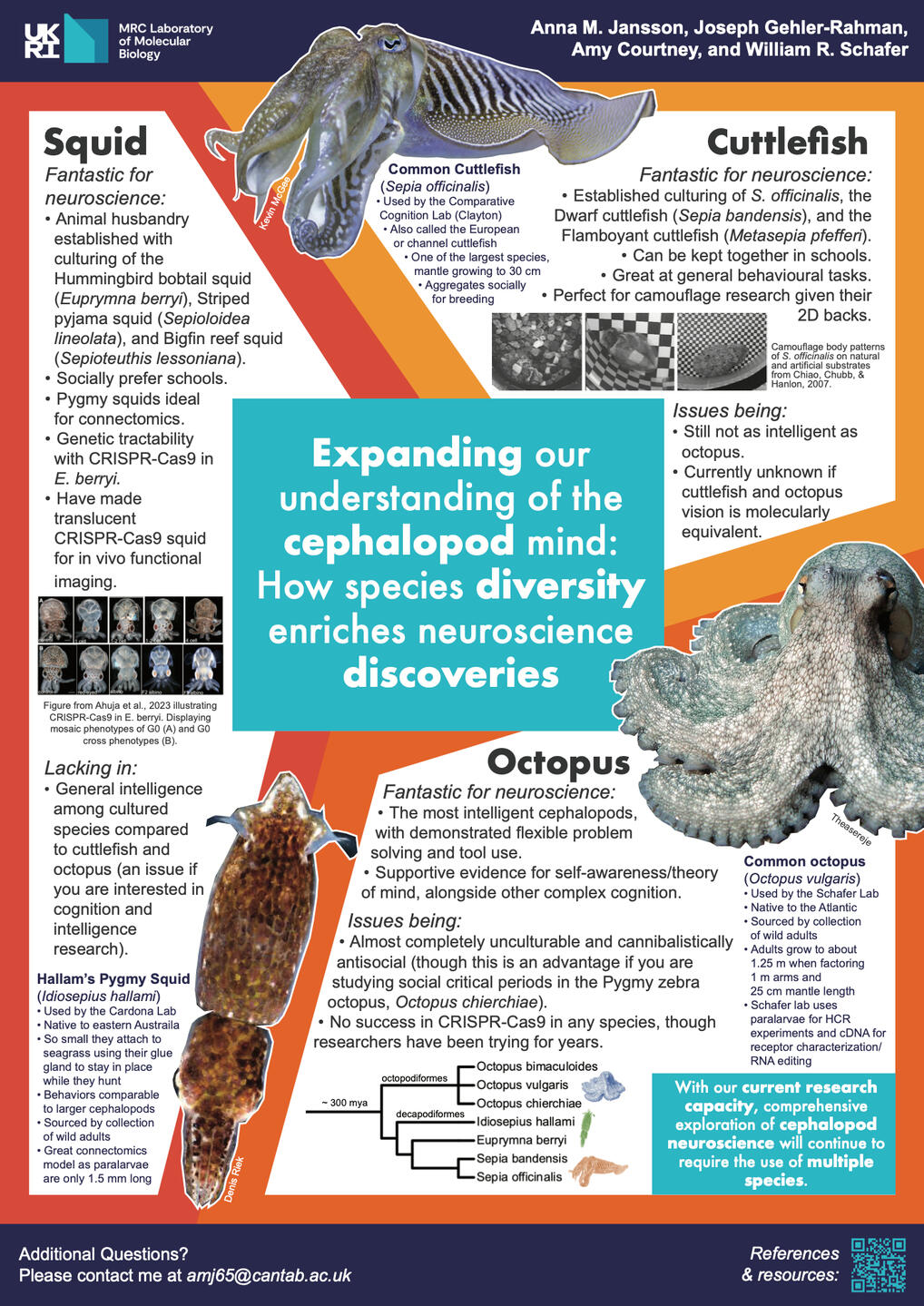
Poster presentation and data blitz selection for the 35th annual Cambridge Neuroscience Seminar “CNS2025: Exploring the Horizons of Brain Research”Selected for a special design prize.Abstract: Cambridge, cephalopods, and neuroscience have a longstanding connection, tracing back to the use of the squid giant axon to develop the 1963 Nobel prize winning Hodgkin-Huxley model of the action potential. Entering the current global renaissance of cephalopod neuroscience, research groups in Cambridge continue to utilise cephalopods as model organisms due to their capacity for intelligence and novel physiology. In particular, their body-centric nervous system, camera-type eyes, camouflage capabilities, and distinct evolutionary distance from mammals. Unlike the use of a standardised model species, cephalopod neuroscience research includes generalisations across a variety of species in order to support the exploration of more diverse questions. In Cambridge, this work is done with the pygmy squid (Idiosepius hallami, Cardona lab), the common octopus (Octopus vulgaris, Schafer lab), and the common cuttlefish (Sepia officinalis, Clayton lab). This local research includes connectomics, vision, RNA editing, and complex cognition, advantageously contributing to the global development of cephalopods as model organisms for neuroscience research, particularly in the broader context of evolutionary and comparative studies. Another component of this diverse species use results from difficulties in animal husbandry and technique adaptation, solidifying the need for species variety now and in the foreseeable future. Overall, the diverse species approach does seem efficient but does risk overgeneralisation between species. Standardisation of a cephalopod model could facilitate a deeper understanding of the unique evolutionary adaptations of a particular species or support faster biotechnology related discovery, but excluding any particular variety at this stage would severely limit the methodological capacity of the subfield.Themes: Neurons, Circuits and Networks, The Social Brain
Keywords: model organism, cephalopod, cognition, vision, connectomics, RNA editing
References
Summary of current methods in cephalopod research
Baden T, Briseño J, Coffing G, Cohen-Bodénès S, Courtney A, Dickerson D, Dölen G, Fiorito G, Gestal C, Gustafson T, Heath-Heckman E, Hua Q, Imperadore P, Kimbara R, Król M, Lajbner Z, Lichilín N, Macchi F, McCoy MJ, Nishiguchi MK, Nyholm SV, Otjacques E, Pérez-Ferrer PA, Ponte G, Pungor JR, Rogers TF, Rosenthal JJC, Rouressol L, Rubas N, Sanchez G, Santos CP, Schultz DT, Seuntjens E, Songco-Casey JO, Stewart IE, Styfhals R, Tuanapaya S, Vijayan N, Weissenbacher A, Zifcakova L, Schulz G, Weertman W, Simakov O, Albertin CB. Cephalopod-omics: Emerging Fields and Technologies in Cephalopod Biology. Integr Comp Biol. 2023 Dec 29;63(6):1226-1239. doi: 10.1093/icb/icad087.Regarding relative cephalopod cognition (there are many more papers by Schnell and Clayton that one can also explore)
Schnell AK, Clayton NS. Cephalopod cognition. Curr Biol. 2019 Aug 5;29(15):R726-R732. doi: 10.1016/j.cub.2019.06.049.CRISPR-Cas9 for E. berryi albino squid line (including figure used here)
Ahuja N, Hwaun E, Pungor JR, Rafiq R, Nemes S, Sakmar T, Vogt MA, Grasse B, Diaz Quiroz J, Montague TG, Null RW, Dallis DN, Gavriouchkina D, Marletaz F, Abbo L, Rokhsar DS, Niell CM, Soltesz I, Albertin CB, Rosenthal JJC. Creation of an albino squid line by CRISPR-Cas9 and its application for in vivo functional imaging of neural activity. Curr Biol. 2023 Jul 10;33(13):2774-2783.e5. doi: 10.1016/j.cub.2023.05.066. Epub 2023 Jun 20.CRISPR-Cas9 in Doryteuthis pealeii (Longfin inshore squid)
Crawford K, Diaz Quiroz JF, Koenig KM, Ahuja N, Albertin CB, Rosenthal JJC. Highly Efficient Knockout of a Squid Pigmentation Gene. Curr Biol. 2020 Sep 7;30(17):3484-3490.e4. doi: 10.1016/j.cub.2020.06.099. Epub 2020 Jul 30.Pygmy squid use for comparative connectomics (more to come, Dr. Correia to publish on her thesis work)
Barsotti E, Correia A, Cardona A. Neural architectures in the light of comparative connectomics. Curr Opin Neurobiol. 2021 Dec;71:139-149. doi: 10.1016/j.conb.2021.10.006. Epub 2021 Nov 24.Fundamental work in cuttlefish camouflage (including figure used here)
Chiao CC, Chubb C, Hanlon RT. Interactive effects of size, contrast, intensity and configuration of background objects in evoking disruptive camouflage in cuttlefish. Vision Res. 2007 Jul;47(16):2223-35. doi: 10.1016/j.visres.2007.05.001. Epub 2007 Jun 25.Schafer Lab preprint on novel dopamine-gated cation channel and acetylcholine-gated anion channel in the Octopus visual system
Courtney A, Styfhals R, Van Dijck M, Boulanger J, Geenen L, Lanoizelet M, Hardege I, Lassnig M, Jansson AM, Gehler-Rahman J, Almansa E, Obenhaus HA, Seuntjens E, Schafer WR.
Novel dopaminergic neurotransmission in the Octopus visual system. bioRxiv. 2025.04.02.646353; doi: 10.1101/2025.04.02.646353.Cell type RNA-seq paper for Octopus vulgaris (others exisit for many species)
Styfhals R, Zolotarov G, Hulselmans G, Spanier KI, Poovathingal S, Elagoz AM, De Winter S, Deryckere A, Rajewsky N, Ponte G, Fiorito G, Aerts S, Seuntjens E. Cell type diversity in a developing octopus brain. Nat Commun. 2022 Nov 30;13(1):7392. doi: 10.1038/s41467-022-35198-1.
Resources
Schafer Lab WebsiteComparative Cognition Lab (Clayton) WebsiteCardona Lab WebsiteContact info for cuttlefish culture at the Marine Biological Association (UK)Marine Biological Laboratory (USA) cephalopod culturing information
Please reach out via email or connect with me and send me a message on the social media platform of your choice. Happy to answer questions about my projects, my path to research, and my advocacy work. Also keen to discuss research collaborations and scientific communication opportunities.
ajansson [at] wisc.edu
amj65 [at] cantab.ac.uk